What Is a Marketing Policy? A Framework for Brand Teams
Brand StrategySeptember 21, 2026
What Is a Marketing Policy? A Framework for Brand Teams
A marketing policy is the set of rules a company uses to keep its marketing consistent, compliant, and on-brand across every channel and every person producing it. Here is what a working policy actually covers, how it differs from brand guidelines, and what keeps a policy enforced instead of filed away.
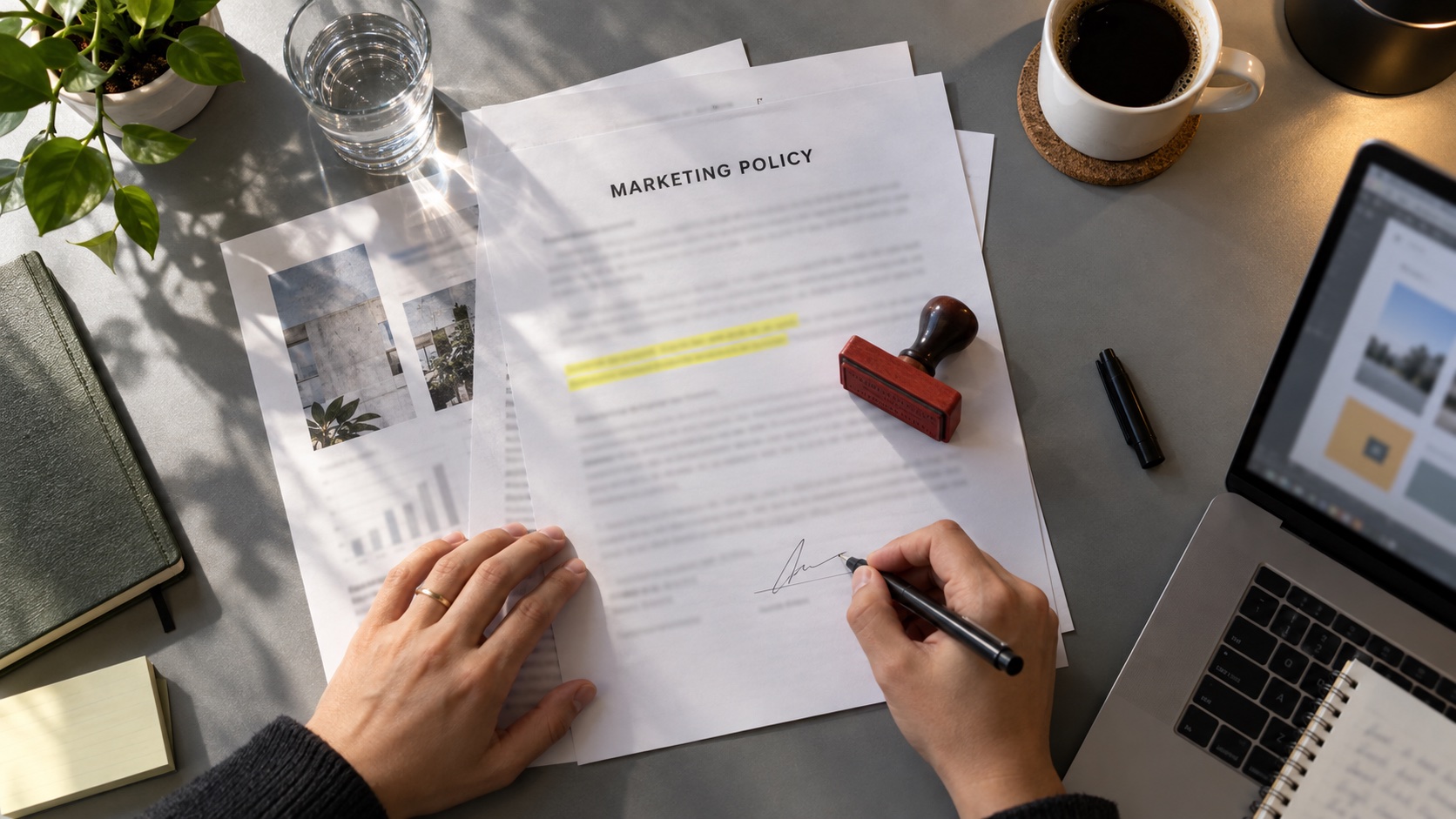
A marketing policy is the set of rules a company uses to keep its marketing consistent, compliant, and on-brand across every channel and every person producing it. It is not a slogan and it is not a mission statement. It is the document that tells a designer, a copywriter, an outside agency, or a new hire what they can say, what they can show, and what needs sign-off before it goes out. Here is what a working policy actually covers, how it differs from brand guidelines, and what keeps a policy enforced instead of filed away.
What a Marketing Policy Actually Covers
A marketing policy is a governance document. It sets out who can do something and under what process, which is a different job than describing how the brand should look. A complete one usually covers:
Brand usage rules: how the logo, voice, and imagery can and cannot be represented, and who is allowed to authorize an exception.
Claims and compliance: what marketing is permitted to promise, any industry-specific restrictions (health, finance, and similar regulated categories carry real legal exposure here), and what triggers legal or compliance review before publishing.
Approval workflow: who signs off at each stage of production, and what happens when a deadline arrives and nobody has.
Channel-specific rules: disclosure requirements on paid media, guidelines for employee and influencer social conduct, and how user-generated content gets cleared before a brand reuses it.
Data and privacy rules: consent language for anything collected through a campaign, tracking disclosures, and how long that data is retained.
A policy missing any of these gets tested exactly where it has no answer, and that usually happens under deadline pressure.
Marketing Policy vs. Brand Guidelines: Different Documents, Different Jobs
Brand guidelines describe how the brand should look and sound: the visual system, the tone of voice, the do's and don'ts of applying a logo. A marketing policy describes what marketing is allowed to do and who has the authority to allow it, which is a governance question rather than an aesthetic one.
Treating them as the same document is a common and costly mistake. A team that hands a new hire a brand guidelines PDF and calls it "the policy" discovers the gap the first time something ships that should have gone through legal review, or a claim gets made that the guidelines never addressed because guidelines are not built to address it. For a closer look at how the production side of marketing has been changing, our covers where the execution layer is headed; a policy is what governs that execution regardless of who or what is doing it.
Building a Marketing Policy People Actually Follow
A policy that lives in a slide deck nobody reopens after the kickoff meeting has stopped doing its job. What makes a policy usable in practice:
Write it in plain language, tied to real decisions. "Get legal sign-off before making a comparative claim about a competitor" is a rule someone can follow. Compliance-department phrasing that requires a second read is a rule people route around.
Put it where the work happens. A policy referenced next to the templates, briefs, and approval tools a team already uses gets consulted. A policy in a separate binder or a rarely opened wiki page does not.
Review it on a fixed schedule, not "as needed." As-needed review means never, in practice, until something goes wrong forces it. A policy that has not been revisited since a rebrand or a new regulation is a liability, not a safeguard.
Name one accountable owner for updates. A policy owned by "the marketing team" collectively is owned by no one specifically, and updates stall for exactly that reason.
Where the Policy Breaks Down: Production at Volume
The place a marketing policy is hardest to hold together is not the document itself. It is production. A policy the whole team can quote accurately gets bent the moment output has to scale across dozens of assets a month for half a dozen channels, because skipping the review step is usually the fastest way to hit a deadline.
This is the part a creative production partner is positioned to solve differently than a policy rewrite can. At BMI Studios, one of the six capabilities we build around is what we call Creative Systems & Asset DNA, "your brand, systematized" (bmistudios.com/what-we-do). The idea is to build the brand's rules into the production system itself rather than checking for them after a piece of creative is already finished. When usage rules, claim limits, and approval routing are built into how assets get made, the policy holds at whatever volume marketing actually needs to produce, instead of depending on every individual contributor remembering it under deadline.
Frequently Asked Questions
What should a marketing policy include at minimum?
Brand usage rules, an approval workflow that names who signs off and when, compliance and claims limits specific to the industry, and channel-specific rules covering paid media disclosure, employee conduct, and any influencer or user-generated content.
How is a marketing policy different from a marketing plan?
A marketing plan is what a team intends to do in a given quarter or year: goals, campaigns, budget. A marketing policy is what any marketer is or is not allowed to do, regardless of which plan they are currently executing. A marketing plan changes every planning cycle. A policy should hold steady far longer than that.
Who should own a company's marketing policy?
That depends on how the company is structured, so confirm it internally rather than assuming a default. Commonly it sits with whoever leads marketing operations, working alongside legal or compliance for regulated claims, with one named person accountable for keeping it current rather than a committee.
How often should a marketing policy be reviewed?
At minimum once a year, and immediately after any change to relevant regulation, a rebrand, or the addition of a channel the current policy does not address.
Does a marketing policy apply to AI-generated content?
Yes, and an up-to-date policy increasingly has to say so explicitly: whether AI-produced copy or imagery requires disclosure, what review that output needs before it publishes, and how the existing brand and compliance rules apply when a system produces the first draft instead of a person.
If your marketing policy is not keeping pace with how fast your team is actually producing work, talk to our team about building a brand system that holds the policy in place at scale.
Frequently Asked Questions
A studio that produces finished creative with AI rather than one that sells access to AI tools. We concept, art direct, and produce the work end to end: brand systems, product and lifestyle imagery, social, UGC, brand films, and full commercials. The output is the deliverable, not a subscription.
Six capabilities that are sold as one system: Brand Design, Creative, Production, AI Realism, Creative Systems and Asset DNA, and AI Video. A project can use one of them or run across all six. Each has its own page under What We Do.
No. People lead every idea. AI is how we explore and produce it faster.
No. Direction, taste, and judgment are the job, and those stay with people. What changes is that exploration and production stop being the bottleneck, so a team spends its time on the decisions that matter rather than on execution.
For most product, lifestyle, and talent work, yes. See the AI Realism page for the quality bar.
Done right, no. That is the entire point of this capability.
Yes, including consistent talent across a campaign. See Creative Systems and Asset DNA.
Finished video. We board and produce actual footage; the character sheets and stills are assets and frames from the process.
Yes, plus the machine-readable version that keeps your AI creative on brand.