
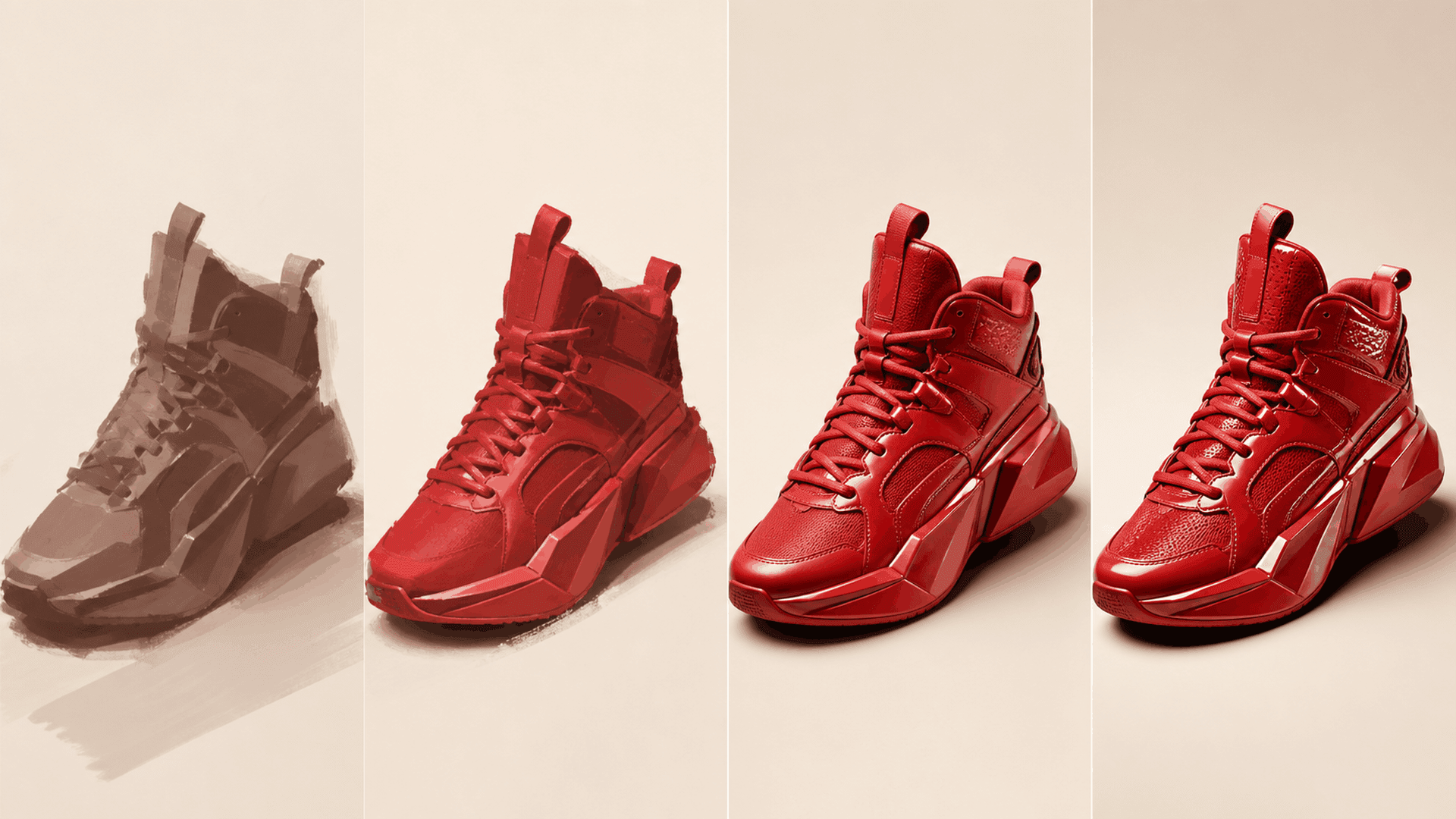
An AI creative workflow is not what most people picture. It is not a prompt box that turns a sentence into a finished campaign. A real AI creative workflow puts human judgment at the front and the back, with AI doing the heavy lifting in the middle, and the difference between studios comes down to how seriously they take the human parts. At BMI Studios we are an AI-native studio, so this is not theory for us, it is how the work gets made every day. Here is a transparent, step-by-step look inside, because the more you understand the workflow, the easier it is to tell a real studio from a prompt farm.
The Myth of the One-Prompt Campaign
The popular image of AI creative is someone typing a clever prompt and receiving a polished ad. That image is also the source of most of the bad AI work in the world. When a studio treats generation as the whole job, the output is fast, cheap, and forgettable, which is precisely the outcome the research keeps warning about. Forrester found that most marketing agencies now treat AI mainly as a way to cut costs, and that the resulting emphasis on efficiency is undermining creativity and long-term brand growth (Forrester, 2026). The tool did not cause that. The workflow did. A good AI creative workflow is built specifically to avoid it.
Our AI Creative Workflow, Step by Step
Here is the actual shape of a project. The tools change constantly, but the structure does not.
1. Direction first, before anything is generated
Every project starts the way a traditional one does, with human creative direction. We develop the concept, gather references, and set the brand constraints: the palette, the tone, the do-not-cross rules, the specific thing this piece has to communicate. This is the part that decides whether the output will be any good, because a model generates against the direction it is given, and vague direction produces generic results. We spend real time here on purpose. It is cheaper to think before you generate than to sort through a thousand aimless outputs after.
2. Generation in the middle, where AI does the volume
Once the direction is set, AI does what it is genuinely great at: producing volume and variation fast. We generate options, explore angles, and produce the hero assets, whether that is imagery, product visuals, or video. This is where the speed and cost advantages of AI actually live, and they are real. A directed pipeline can produce in hours what used to take a week, and it can produce many more variations for testing than a manual process ever could. But volume is raw material, not a finished product. The next step is what turns it into work.
3. Human review and refinement, where taste does the filtering
Every output that moves forward passes through human review. This is the step that separates strong AI work from the generic flood, because the model does not know when something is off-brand, derivative, subtly wrong, or simply not good, and an experienced person does. We cut ruthlessly, refine what survives, and send the near-misses back with sharper direction. When anyone can generate a competent image, the scarce and valuable skill becomes knowing which of a hundred is actually right and why, which is exactly the kind of judgment the World Economic Forum ranks among the fastest-rising skills of the period (World Economic Forum, 2025).
4. Assembly, finish, and delivery
The last stage is production finishing, and it matters more than people expect. Selected assets get assembled, retouched, color-treated, and for video, edited, graded, and scored. A human quality pass checks brand fidelity and craft before anything leaves the studio. This human-in-the-loop finish is what industry practitioners increasingly agree separates usable AI production from demo reels (Lemonlight, 2026). The work ships when it meets the standard, not when the model stops generating.
Where the Humans Matter Most
If you map that workflow, the AI sits in one stage and humans own the two on either side of it, which is the opposite of how people imagine an AI studio works. The humans matter most at the decisions the model cannot make: the original concept, the brand judgment, the taste call on which output is right, and the honest assessment of when something is not working. These are not nostalgic hold-outs. They are the parts that create value, and they are getting more valuable as generation gets cheaper, not less. We wrote more about that shift in how creative AI is changing creative work.
The Tools Are Infrastructure, the Direction Is the Product
This is the core of an AI-native studio's philosophy, and it is worth stating plainly. The generative tools are production infrastructure, like cameras and edit suites before them. They are not the creative act. A studio that lets the model make the creative decisions is not being efficient, it is outsourcing the one thing a client is actually paying for. The studios that treat AI as a way to remove creatives produce the forgettable output the market is about to be flooded with. The ones that treat it as a way to give great creatives more range produce work that stands out precisely because so much of the alternative is generic. That distinction is the whole difference between the two production models we compared in AI creative agency versus traditional agency.
What Brands Should Look For in an AI Studio
If you are hiring one, the workflow is the thing to interrogate, not the tool list. Ask where human direction enters and how. Ask who reviews output and against what standard. Ask how brand consistency is enforced, and listen for whether the answer is a real process or a hope that the model remembers the guidelines. A studio with a serious workflow will happily walk you through all of it, because the process is the product. A prompt farm will change the subject to how fast and cheap it is. Speed and cost are real benefits, but on their own they buy you the forgettable version. The workflow is what buys you the good one.
Frequently Asked Questions
What is an AI creative workflow?
It is the end-to-end process an AI-native studio uses to make creative: human direction and briefing first, AI generation in the middle for volume and variation, human review and refinement to filter for quality and brand fit, and a production finish for assembly, retouching, and delivery. The AI occupies the middle stage; humans own the direction and the judgment on either side.
Does an AI studio replace the creative team?
No, it changes what the creative team does. The repetitive execution automates, while direction, taste, brand strategy, and quality control become the core of the work. A good AI studio is not a smaller team doing less, it is a team spending its time on the decisions that actually determine whether the work is good.
How do you keep AI output on-brand?
By treating brand consistency as a direction-and-review problem, not a model-memory problem. The brand is encoded into the brief and references, generation happens within those constraints, and a person enforces them at review before anything ships. Trusting the model to simply remember the guidelines is how off-brand work slips out.
Is an AI creative workflow actually faster?
Yes, meaningfully, because the generation stage compresses work that used to take days into hours and allows far more variation. But the speed comes from the middle of the workflow, not from skipping the direction and review stages. Studios that cut those to go faster produce the generic output that costs more in the long run.
What should I look for when hiring an AI creative studio?
A real workflow with human direction at the front and back, a clear standard for review, and a concrete answer for how brand consistency is enforced. If a studio can walk you through its process in detail, that is a good sign. If it mostly sells speed and price, expect speed and price, and generic creative.
The Bottom Line
An AI creative workflow is not a shortcut around creative work, it is a new way of structuring it: human direction, AI production, human judgment, human finish. The AI-native studios worth hiring are the ones that take the human bookends as seriously as the automated middle, because that is what turns cheap, fast generation into work that is actually good. The tools are infrastructure. The direction is the product.
That conviction is how we built BMI Studios. If you want to see what an AI-native creative workflow could produce for your brand, talk to our team.